Teenage Engineering EP-1320 Medieval – a sampler full of lutes, bagpipes and monks
As an Amazon Associate I earn from qualifying purchases. It costs you nothing extra.

Every beat machine I’ve ever seen comes loaded with the same 808 kick, the same snappy snare and the same hi-hat. Fine. But nobody ever asked: what if the drummer was a monk?
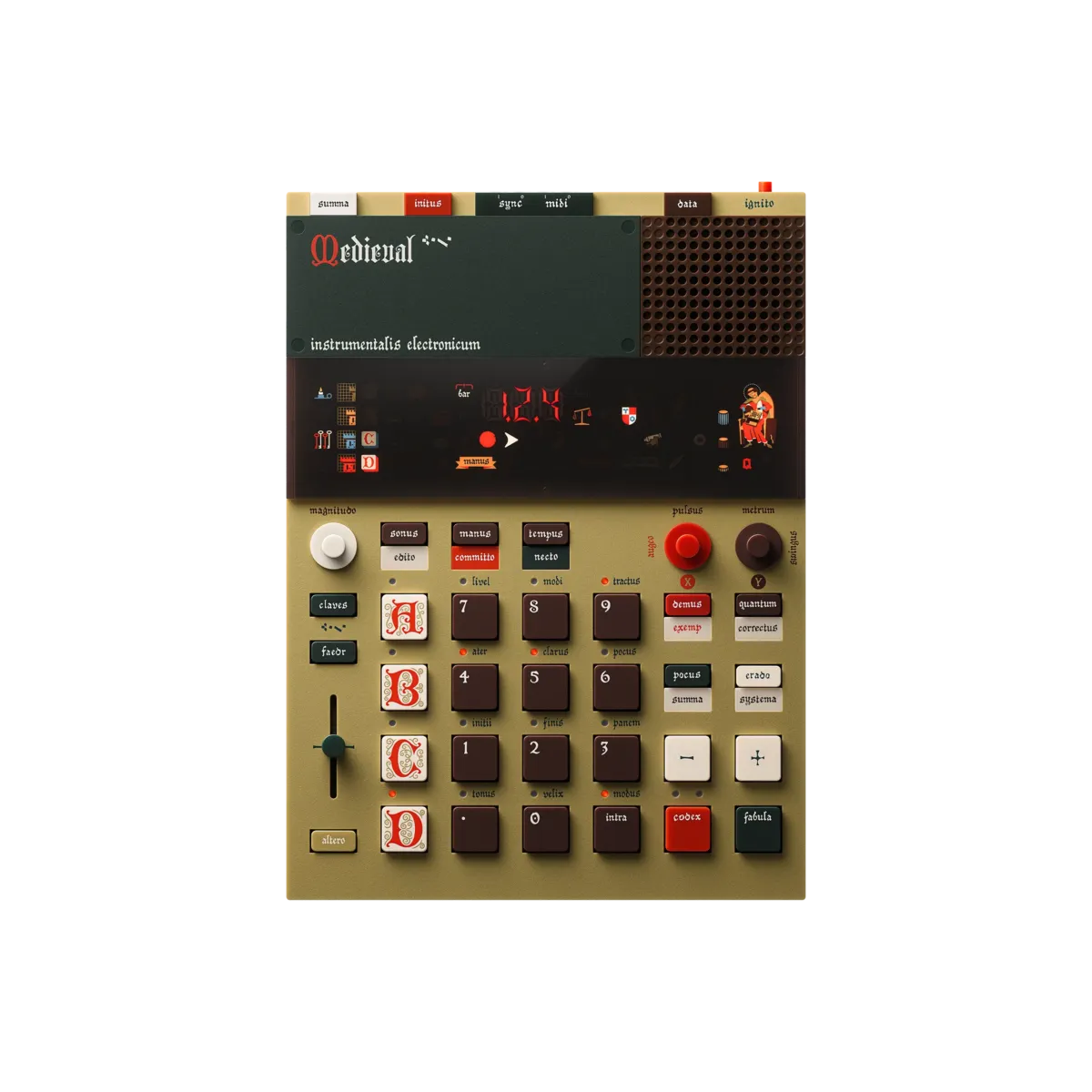
Teenage Engineering asked. The EP-1320 Medieval is a medieval sampler: a flat, tablet-sized beat machine stuffed with hurdy gurdys, lutes, bagpipes, Gregorian chants and the sound of coconut halves pretending to be horse hooves. The Swedish company calls it the ultimate, and only, medieval beat machine. I believe them.
It’s a joke you can actually make music with, and that’s exactly why I want one.
What is the EP-1320 Medieval?
Under the gothic lettering, it’s the same flat hardware as the EP-133 K.O. II, Teenage Engineering’s popular sampler and sequencer. It launched in August 2024 with a new skin, a new sound library and some new tricks.
The skin is the fun part. The labels are in fake Latin (“instrumentalis electronicum”), the pad labels look like letters from an illuminated manuscript, and Teenage Engineering says the pads are cocoa-scented. The effects got names like “torture chamber reverb” and “dungeon echo”.
The sound library is the useful part. According to the maker it has:
- Strings like hurdy gurdy, citole, gittern and bowed harp
- Bagpipes, shawms, flutes and trumpets
- Frame drums, battle toms, bells, chain rattles and those coconut hooves
- Foley sounds: swords, arrows, farm animals, witches, peasants and a dragon
- Gregorian chants, plus 9 demo songs to get you started
How does it work?
You tap out patterns on the pressure-sensitive pads and build songs with the sequencer: 9 projects, up to 12 tracks per pattern and 99 bars per pattern. It plays 12 mono or 6 stereo voices at once. A multifunction fader handles punch-in effects for playing live, and there’s a new arpeggiator.
You can also record your own sounds with the built-in mic or the line input. It runs on 4 AAA batteries or USB-C, has a speaker, and talks MIDI and sync to other gear. Memory is 128 MB, but 96 MB of that holds the medieval library. That leaves 32 MB for your own samples.
The good and the not-so-good
What I like, on paper:
- Nobody else sells this. If you want a lute riff over a battle drum, this is the shortest route.
- Nick Batt of SonicLAB found it surprisingly musical once you get past the theme, and it adds loop points, multi-sample regions and new effects over the K.O. II.
- Battery power, a speaker and a mic make it a real couch-and-train instrument.
- Wallpaper* called it “definitely and delightfully different”. Hard to argue.
What could be better:
- 32 MB for your own samples is not a lot.
- Batt’s verdict: it feels a bit like a novelty, and the regular K.O. II is the more versatile choice for most people.
- If medieval music isn’t your thing, the joke wears off and you’re left with a K.O. II in a costume.
Who is the EP-1320 Medieval for?
Teenage Engineering fans who already own a K.O. II and want a second one with a personality. Game composers and people who make music for tabletop RPG nights. Anyone whose favorite part of a Renaissance fair is the bagpipe guy.
If you want one sampler for every genre, get the K.O. II instead. And if you mostly want to loop your own playing live, a dedicated looper like the Boss RC-505 makes more sense. Want something cheaper and just as silly? The Stylophone Beat is a drum machine you play with a pen.
Where can I buy the EP-1320 Medieval?
Teenage Engineering sells it through its own Amazon store. Synthtopia notes it costs the same as the K.O. II.
Bring your own lute. Or don’t, it’s already in there. For more toys that make noise, see our most fun music gadgets for musicians.