Korg phase8 – a synthesizer you can play with a rock
As an Amazon Associate I earn from qualifying purchases. It costs you nothing extra.
Synth people argue about analog versus digital the way football fans argue about referees. Loudly, forever, and nobody changes their mind.
Korg skipped the argument. The Korg phase8 is an acoustic synthesizer: the sound comes from eight steel strips that physically vibrate on top of the box.
It’s the strangest instrument Korg has put in a shop in years, and I can’t stop watching videos of it.
What is the Korg phase8?
The phase8 comes from Korg Berlin, a small R&D team led by Tatsuya Takahashi. He’s the engineer behind the Volca series and the Minilogue, so he knows a thing or two about making synths people actually buy.
Korg first showed prototypes at Superbooth in 2024. The production version came out at NAMM in January 2026. Preorders opened right away, and Engadget reported that sales would start in April. In the US it costs 1,149.99 bucks.
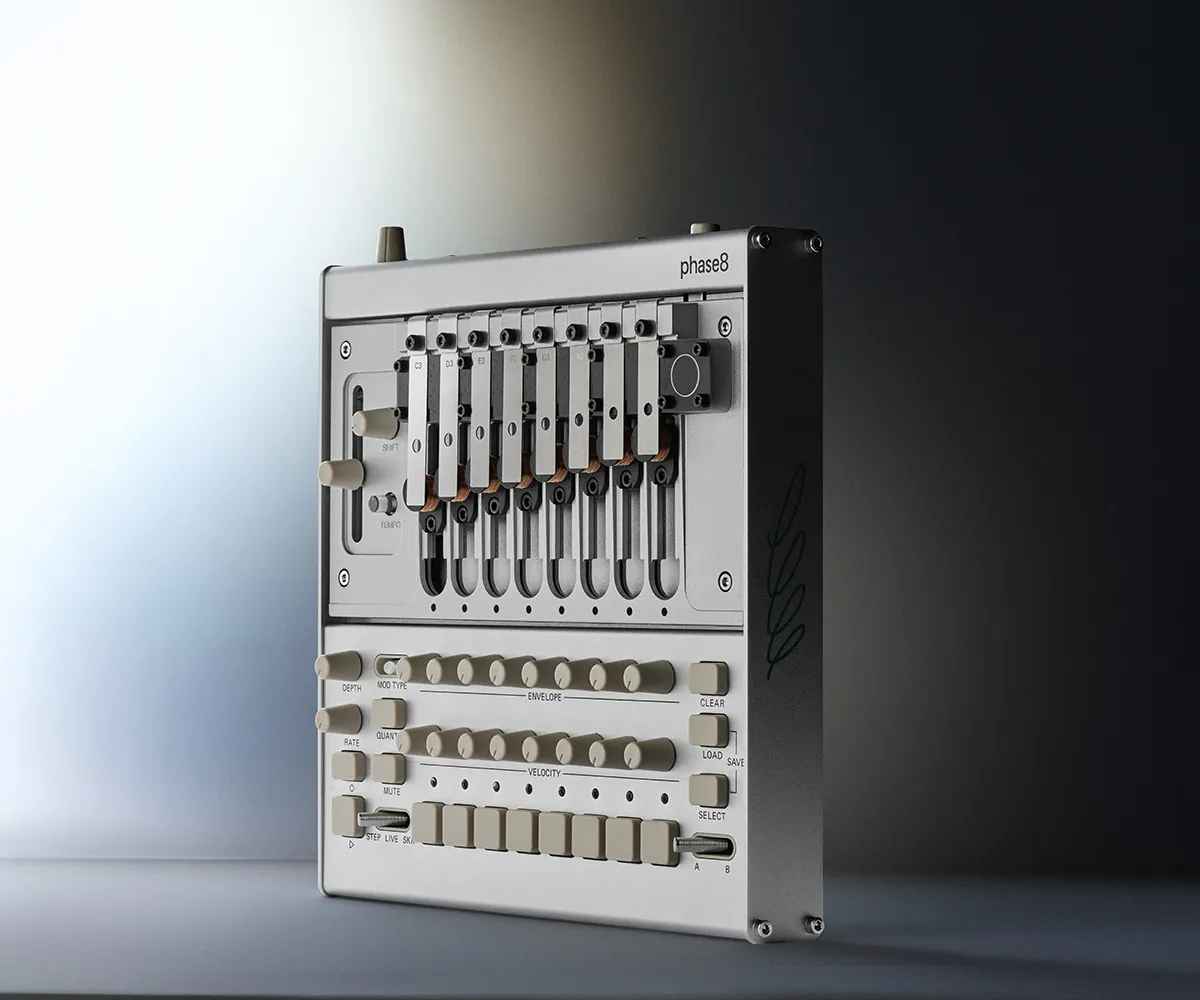
It’s a silver desktop box of about 9 by 9 inches that weighs 3.77 pounds. The top half holds the resonators. The bottom half looks like a drum machine, with a row of step buttons and two rows of knobs.
How does it work?
Each of the eight voices is a small steel resonator, and Engadget describes the sound as kalimba-like. An electromagnetic driver makes each one vibrate, and the synth controls that with envelopes, from short percussive hits to long, ringing notes. Korg calls this “acoustic synthesis.”
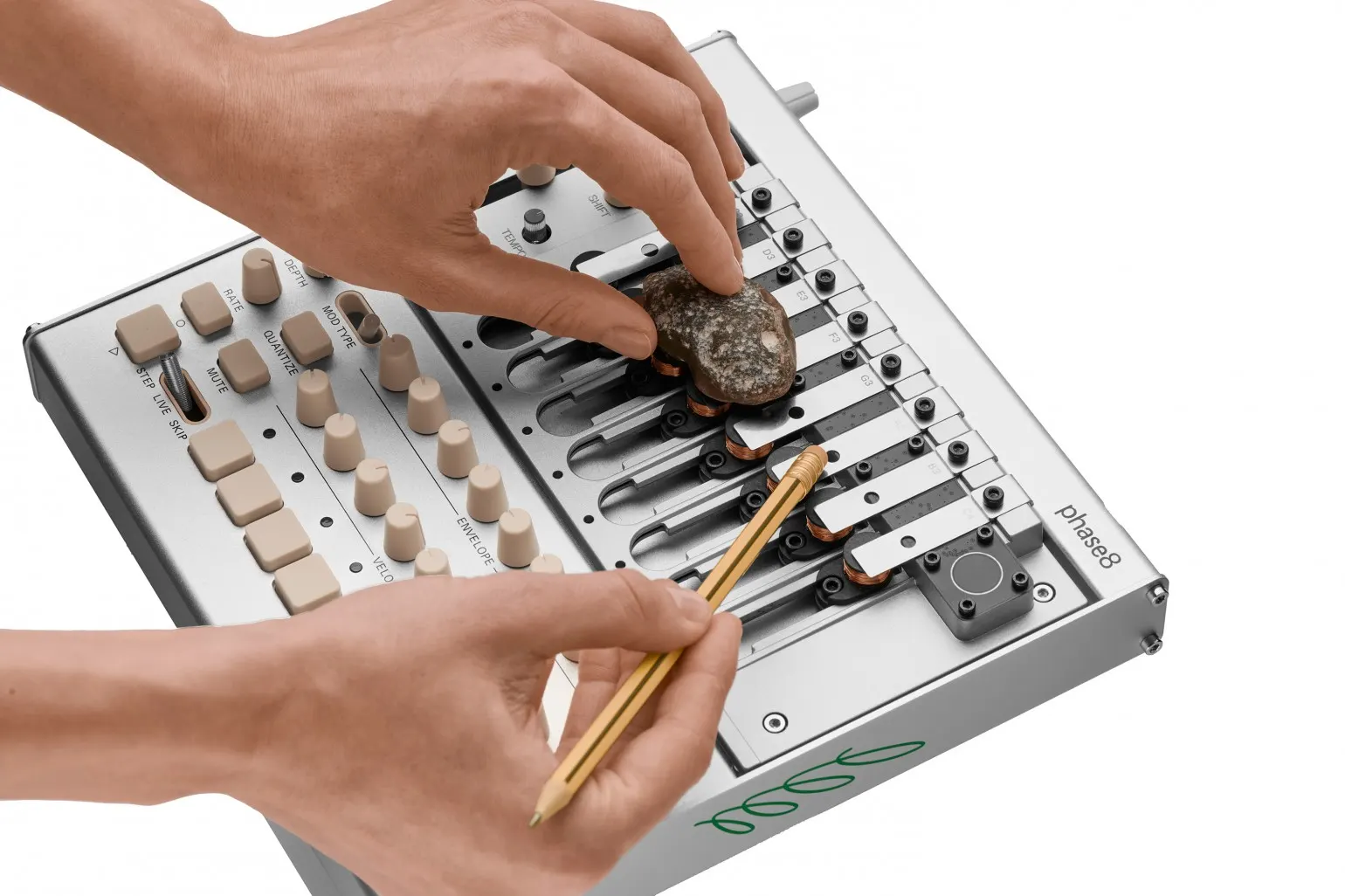
Because the sound is physical, you can mess with it. Korg says you can touch, pluck, strum or tap the resonators, or put found objects on them. Korg’s own photos show someone playing it with a rock and a pencil. An AIR slider sets how much of that acoustic noise gets through.
Other things Korg lists:
- 13 chromatically tuned resonators in the box. Eight fit at a time, so you pick your own scale, and you can retune them.
- A polymetric step sequencer with live recording and eight memory slots.
- Modulation modes, including tremolo and two audio-rate effects.
- MIDI, USB-MIDI, sync in and out, and a CV input to play along with other gear.
- A quarter-inch line out and a 3.5 mm headphone out.
The good and the not-so-good
What I like:
- Nothing else sounds like it. Thomann’s reviewer wrote that, as far as they knew, no other device on the market makes this kind of sound.
- It invites play. You’re supposed to touch it, which is not something synths usually encourage.
- Swappable resonators mean the scale isn’t fixed, which helps it fit into songs.
- Korg Berlin picked Floating Points to give it its first big live performance, at Glastonbury. Not bad company.
What could be better:
- It’s over a thousand bucks. That’s a lot for an instrument with eight notes at a time.
- It runs on a 12 V adapter. No batteries, no built-in speaker, so it’s not a couch toy like a Volca.
- It holds eight programs. Fine for jamming, tight for a live set.
- The Amazon listing has no customer ratings yet.
Who is the Korg phase8 for?
Synth nerds who already own the usual boxes and want something new to play with. Sound designers, ambient musicians and anyone making film or game sound will get the most out of it.
It’s not a first synth. If you’re buying for a beginner, the Arturia MicroFreak costs a fraction and does more conventional things very well. For something playful in the Korg family, the Korg NTS-3 Kaoss Pad is a cheap, fun kit. More ideas live in our most fun music gadgets for musicians.
Where can I buy the Korg phase8?
Korg sells the phase8 through its own Amazon store, and it’s also at the big music retailers. It was about 1,150 bucks at the time of writing (October 2026). That’s a serious gift. For the right person, it’s the one they’ll still be talking about in March.