Moog Mavis – a real Moog synthesizer you build yourself
As an Amazon Associate I earn from qualifying purchases. It costs you nothing extra.

I have a weakness for things that come in pieces. IKEA cabinets, LEGO sets, model kits. The building is half the fun, and afterwards you get to say “I made that” every time someone looks at it.
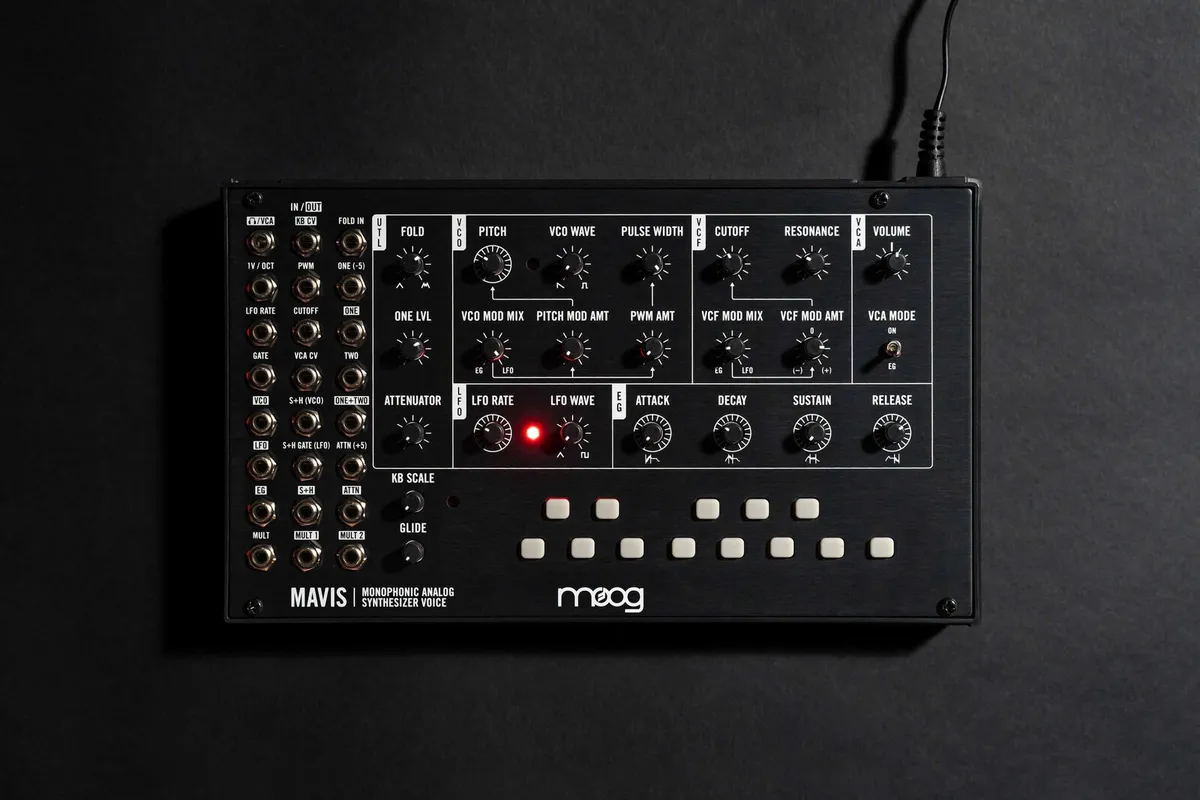
The Moog Mavis is the music version of that. It’s a build-it-yourself analog synthesizer kit from Moog, the company that started the synth craze in the sixties. You screw it together in an afternoon, no soldering needed, and then you own a real Moog.
For the price of a nice pair of earbuds. That’s the part that got me.
What is the Moog Mavis?
Moog Music is named after Robert Moog, who built some of the first commercial synthesizers in the 1960s. Mavis came out in 2022, and Moog pitches it as a “low-cost Moog” for learning synthesis.
It’s a small monophonic analog synth, about 9 by 5.25 inches. Inside are the classic Moog ingredients: an analog oscillator, Moog’s famous -24 dB ladder filter, an envelope and an LFO. Mavis also has a diode wavefolder, which Moog says is the first analog wavefolder on a Moog instrument. It folds the waveform back on itself for brighter, buzzier sounds.
You play it on a one-octave keypad of small buttons, with glide and scaling, and there’s a 24-point patch bay for rerouting the sound with cables.
How does building it work?
The kit comes with the circuit board, the front panel, the case, a clear protective cover, a nut driver, a calibration tool, five patch cables and a power supply. According to the Amazon listing, the only extra tool you need is a small Phillips screwdriver.
You mostly bolt the panel onto the board and tighten nuts onto the patch points. Moog says anyone can finish it in an afternoon. Reviewers were quicker: one called the build a matter of minutes, with most of the time spent on the nuts.
Once it’s built, you can use it on a desk, or take it out of its case and put it in a Eurorack modular system as a 44HP module.
The good and the not-so-good
What I like:
- The build. It turns a synth into a gift with an activity attached.
- A real Moog filter and oscillator for a lot less than other Moogs. MusicRadar concluded it “can’t really be faulted at this price”.
- It grows with you. Moog has free tutorials and patchbooks on its site, and Mavis works with other Moog semi-modulars and Eurorack.
What could be better:
- The knobs are small, which MusicRadar flagged as its main con.
- The keypad is fine for testing, less fun for playing melodies. Some Amazon buyers say it shines most in a modular rack.
- There’s no built-in sequencer, no power switch and no 1/4-inch output, according to early buyers.
- It’s monophonic, so it plays one note at a time. Big chords are not its thing.
Who is the Moog Mavis for?
Tinkerers who like to know how things work, and musicians who are curious about modular synths but scared of the price. It’s also a great gift for anyone who loved our make-your-own music box kit and is ready for the grown-up version.
If they’d rather play songs than patch cables, a synth with a proper keyboard and a sequencer is a better fit. Our list of the most fun music gadgets for musicians has plenty of those, and the Stylophone is a synth you can carry in a coat pocket.
Where can I buy the Moog Mavis?
Moog sells Mavis through its own Amazon store. At the time of writing (October 2026) it was about 260 bucks, down from a list price of about 300.
Build it on Christmas morning, play it by lunch. Take my money!